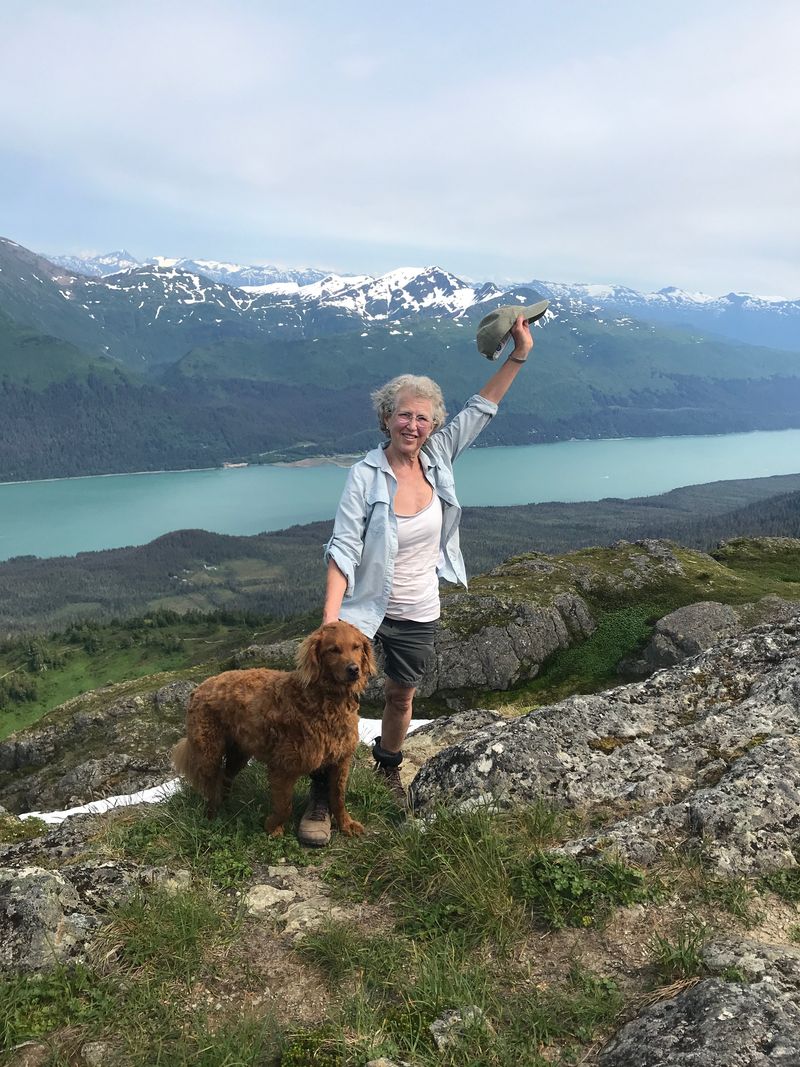
 “I’m looking out of my window and there’s haze from the fires in Canada and the interior,” Population Connection member Joyanne Bloom tells us. “There is pollution from the mines spilling into our rivers. The ocean is warming and acidifying. The fish stocks are diminishing, especially in areas where our Native Alaskans are reliant subsistence on salmon. The Mendenhall Glacier, just 13 miles away, has shrunk back about a mile since I got here in the 1970s.” From her home in Alaska, Joyanne lives in a world where climate change seems to be happening twice as fast as the rest of the country. Here, she sees firsthand how rapidly the world is changing and believes it is imperative that we start taking greater action.
That’s where Population Connection comes in. Joyanne’s lifelong experiences—including traveling internationally and living part-time in South America—have informed her thinking that overpopulation is the root cause of many of our world’s woes.
Joyanne first came to Alaska in the summer of 1972 to conduct fisheries research with her husband. They had been living on the east coast and they were only supposed to be in Alaska for the summer, but, she says: “When you’re living on the ocean and in the forests at the edge of mountains, the pace of life is slower and less materialistic. We just never left.” They were also fortunate to live part-time in Patagonia, South America where they ran a catch-and-release fly fishing lodge. Yearly trips to places like Ecuador, Bolivia, and Peru really pulled her into the population movement. Throughout her travels, she has seen the ramifications of rapid population growth on wildlife, the landscape, and human well-being.
Joyanne worked in fishery conservation in Alaska for many years and, later, in social services and adult education, helping students get GEDs and teaching ESL citizenship classes. She was also on the board of the American Jewish World Service, where she traveled to developing countries: helping with strategic planning in Uganda, teaching English and grant writing in Cambodia, and developing local business plans in rural Mexico. She is a passionate supporter of Population Education and strongly believes that the education of children – and adults – is critical to understanding our impact on the planet.
Joyanne is now retired and still committed to service. Living in Alaska full time, she makes the most out of living on the water and in the mountains. She spends her time hiking, kayaking, and cross-country skiing, and is very involved with her community. Recently, helped start a food pantry and has been a sponsor to four different refugee groups from Ukraine. “I’m an empty nester in a four-bedroom house,” she explains, “and it’s been a privilege to have the families stay in my home before they can move into their own accommodations.”
We are honored to include Joyanne in our ZPG Society. In addition to her yearly support, she established a charitable gift annuity with Population Connection. “It’s a win-win,” she says. “I can feel good about donating but I’m also receiving quarterly checks, which is nice.” Joyanne will continue to receive payments for life. When Joyanne passes, Population Connection will receive the remainder of her initial gift. Joyanne knows she is ensuring her legacy by supporting the critical work of the organization, even after her lifetime.
When asked if she has any thoughts on why others should consider a planned gift, she remarks, “I’m grateful for what you’re doing and I’m even more grateful to be able to support your work. Gratitude is really big in my life. I recognize what I have: my health, my grandchildren, and the means to help other people. I want [my grandchildren] to have appreciation for their privileges, too, and I’m hoping they’ll follow my lead.”
We appreciate Joyanne’s investment in our work and her long-term commitment to global population stabilization. It is an honor to count Joyanne as a member of our ZPG Society! If you’re interested in learning how you can establish a charitable gift annuity or include a gift to Population Connection in your will or trust, please contact us at legacy@popconnect.org. You may also go online to create your will for free, at www.freewill.com/populationconnection. Have you already included us? Please let us know! We’d love to recognize you!